| Last edited | Status |
|---|---|
| March 22, 2026 | Stripe: See “critical role” section. Awesound: Content below is maybe 90% done. Pending: signed letter from a user. (We already have a letter from Greg Clunis.) McKinsey: 100% done. |
The gist: “Mark has built/created many important things that made a difference to others.”
Actions for Fragomen:
- Provide feedback / redraft of letter from Kelly-Anne. Mark’s first draft is here: https://docs.google.com/document/d/1C21SGTmBSQfFqSYNO5d8iT7uEsFxDqmzk8p3aT8Or5A
Research at Berkeley
In 2011, Mr Moriarty published research for Berkeley University. As articulated at the time, “The efficient discovery and management of learning resources remains an important problem.” Findings shared in this research were shared with IEEE (Institute of Electrical and Electronics Engineers, a renowned standards body), Wikipedia, and the Learning Resource Metadata Initiative (“LRMI”, co-led by Creative Commons and the Association of Educational Publishers), to form a common metadata vocabulary for describing learning resources. The work proved high impact, aligning parties on a shared understanding of how best to standardize the categorization of online educational resources. This research proved increasingly valuable as the 2010s saw a major increase in online education, built on the foundations discussed in this paper. In 2026, with online/hybrid learning even higher and artificial intelligence solutions being built for educational uses, the ability to find, categorize and process online material is increasingly important – especially as learning tasks and curriculum details are asked of new A.I. tools.
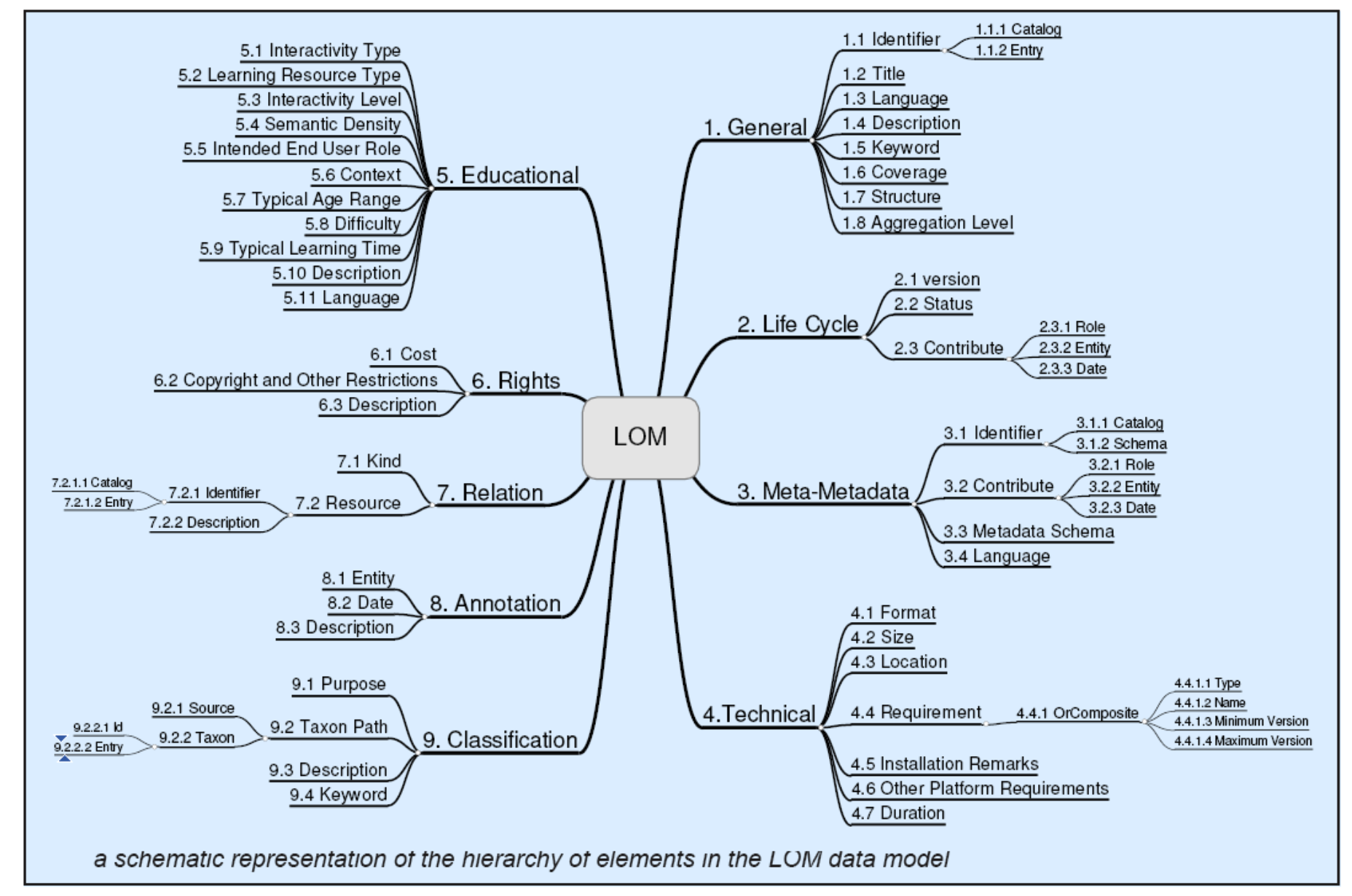 A pre-publication draft (pdf) is here embedded:
This work had applications later in 2025 as Stripe navigated a plethora of pre-existing and nascent “standards” for agentic commerce, and weighed up publishing a new protocol vs. working to existing protocols. Examples in 2025 and 2026: include ACP (Agentic Commerce Protocol), UCP (Universal Commerce Protocol), x402, and Machine Payments Protocol.
Stripe
This surely is duplicative with Claim A, “Critical role”. In this section, perhaps worth briefly repeating some specific artefacts that others used
- Log in with Link: built first prototype, usable on shop.markmoriarty.com, awesound.com/login and loginwithlink.com
- Contributed to ACP, the Agentic Commerce Protocol, http://agenticcommerce.dev
- Contributed 100% of the open-source code for “Tap to Pay” mobile app: https://tappayo.com/code
- Contributed content to keynote presentations at our annual conference (“Stripe Sessions”) and to our Annual Letter, single-handedly wrote the speaking guide for Account Execs at Stripe Sessions, and provided talking points for execs speaking at Davos and at a Senate hearing in D.C.
McKinsey
Note to Fragomen: All “contribution” points are already captured in the original application outlining my “critical role”. I don’t expect to add any further ammunition to this argument.
Awesound
*Note to Fragomen: Here I have added a LOT evidence since December, to bolster our RFE. This might be cross-referenced to Claim A (Critical role in a distinguished org), to show I had a meaningful impact (built product that actually worked, and Awesound is respected/distinguished enough that others do spontaneously promote it on their own website)
Letter from a User
Draft letter from Kelly-Anne Slatton, CeriFi (started using Awesound in 2018) https://docs.google.com/document/d/1C21SGTmBSQfFqSYNO5d8iT7uEsFxDqmzk8p3aT8Or5A
Remote Audio Data
Mr Moriarty was a key contributor to “Remote Audio Data”, an advanced way to bring better measurement to the podcast industry. Mr Moriarty was a key contributor in pushing podcast analytics forward. In 2018, he was one of a handful of industry leaders who came up with a new way of improvement podcast measurement, aligning on a new standard called Remote Audio Data, or RAD for short.
Extract:
Collaborative minds and leaders from across the media industry have worked closely with NPR to develop and launch a new podcast analytics technology: Remote Audio Data (RAD). We are grateful to the enthusiastic, devoted group of organizations that have been a part of the development work. These industry leaders are joining NPR in committing to implement RAD in their products in 2019: Acast, AdsWizz, ART19, Awesound, Blubrry Podcasting [and eight others].
That’s an extract from the following article: https://www.npr.org/sections/npr-extra/2018/12/11/675250553/remote-audio-data-is-here
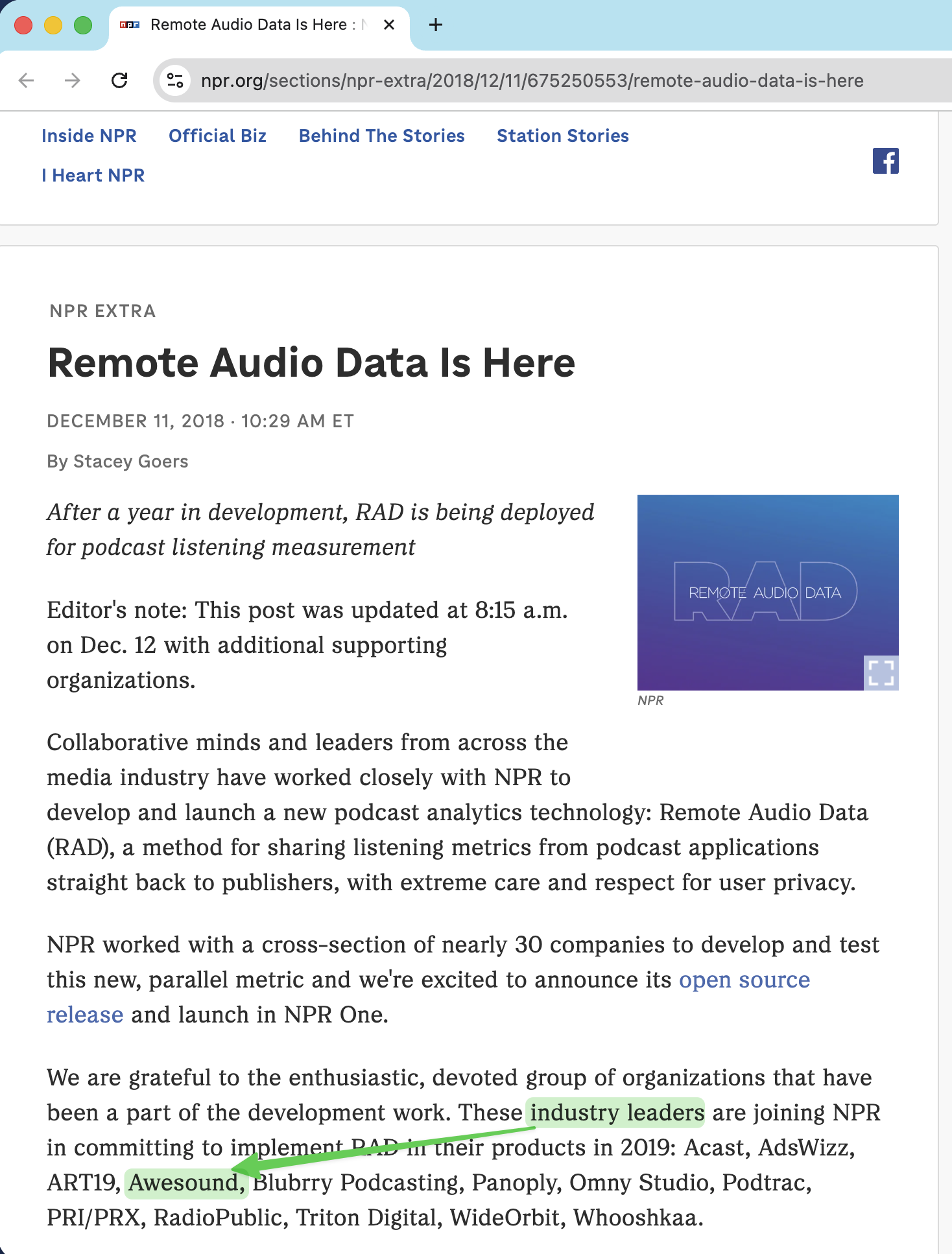
Another extract from a news article at the time:
NPR described its collaboration with Awesound in the following way:
“Measurement has been one of the open challenges in the podcast industry for a long time… Over the course of the past year, we have been refining these concepts and the technology in collaboration with some of the smartest people in podcasting from around the world… 13 companies have so far committed to implementing RAD in 2019, including Acast, AdsWizz, ART19, Awesound, Blubrry Podcasting, Panoply, Omny Studio, Podtrac, PRX, RadioPublic, Triton Digital, and WideOrbit.”
That’s an extract from the following article: https://www.insideradio.com/npr-s-new-podcast-measurement-metric-goes-live/article_903396de-fd8e-11e8-b44e-27c24d654a88.html
Other inventions in podcasting analytics and measurement
Awesound was invited to be a design partner for the above “Remote Audio Data” standard given its leading role in being the first to bring to market several new innovations in podcast analytics.
Despite Awesound being one of the smaller players in the industry, Awesound was first-to market with several important innovations that later became standard. Awesound shared its technical developments and roadmap, raised publisher expectations, and invited others to “catch up”. Podcasting is built on open standards (such as public RSS feeds), and in shipping new features ahead of other players, Awesound brought the entire industry forward.
In 2016, Awesound was the first podcast host to show listener drop-off. Not just “number of downloads”, but showing where in an episode listeners dropped off (or skipped ahead).
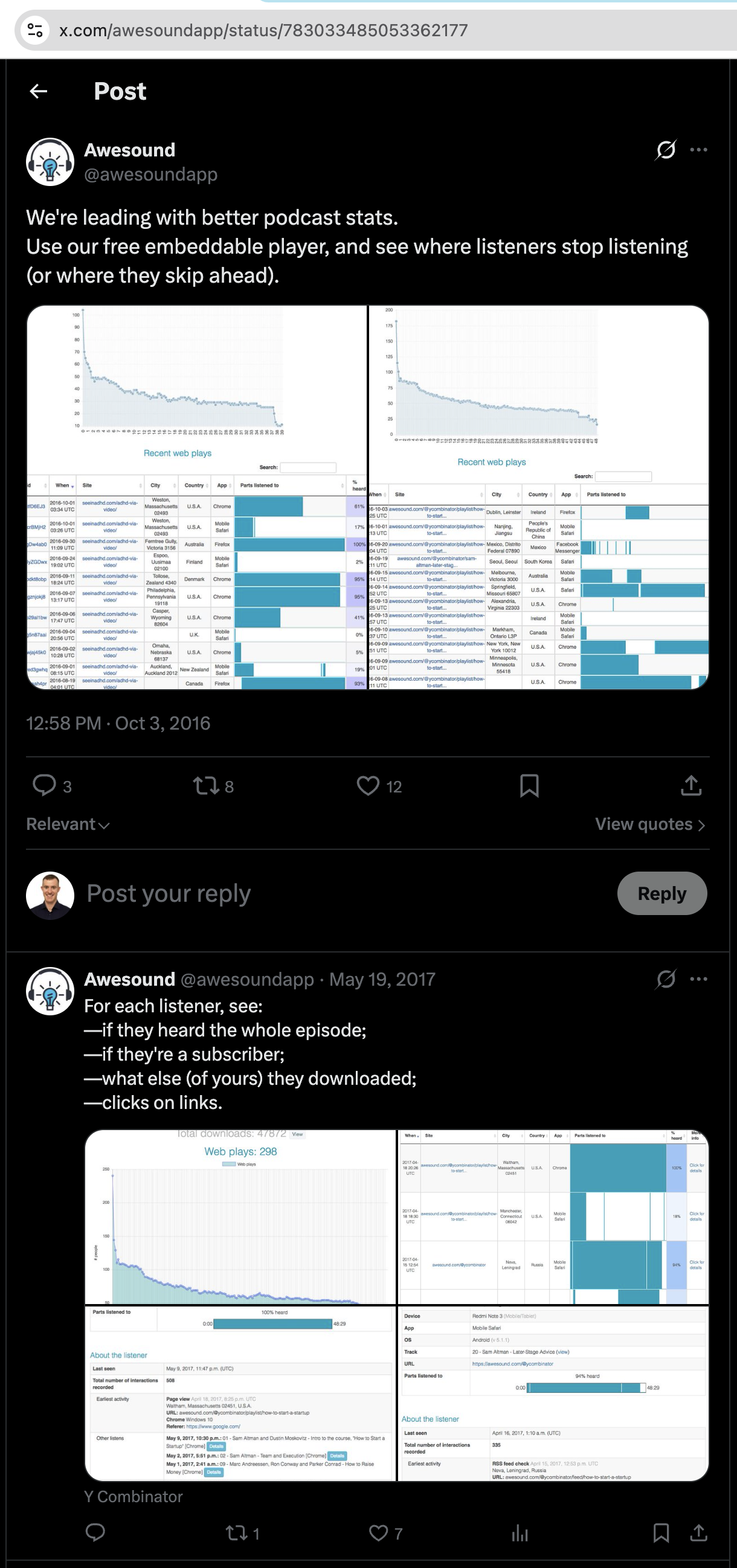 Screenshot from 𝕏 post https://x.com/awesoundapp/status/783033485053362177
In 2019, Awesound was the first podcast platform to offer real-time analytics for web listeners, allowing podcasters to view how many listeners were currently listening:
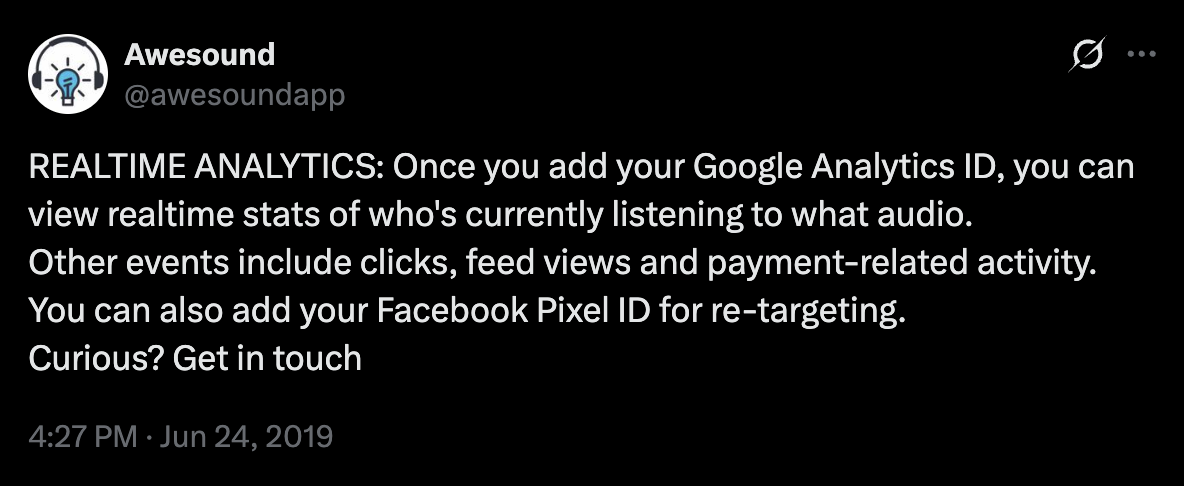 Screenshot from 𝕏 post https://x.com/awesoundapp/status/1143299644866355200
”Podcasting 2.0”
Awesound (specifically Mr Moriarty) was also a design partner for the new “Podcasting 2.0 standard”, which added several important metadata fields into RSS feeds, to support new features like tips, canonical speaker identities (building on his earlier research at Berkely, as mentioned above), and embedded transcripts. Prior to this new development, the “2.0” milestone required creative new thinking, since the ecosystem was in a stable equilibrium (listener apps were reluctant to build support for tags that didn’t exist, while podcast publishing companies were reluctant to add tags that weren’t supported). The groundwork agreed upon by Mr Moriarty and others in 2019 (cataloged on https://podcasting2.org) made years of progress possible, including Spotify adding such features as late as 2025.
More than just audio
Awesound also supports supplementary (non-audio) material, such as accompanying PDFs or other assets (any file format).
Example:
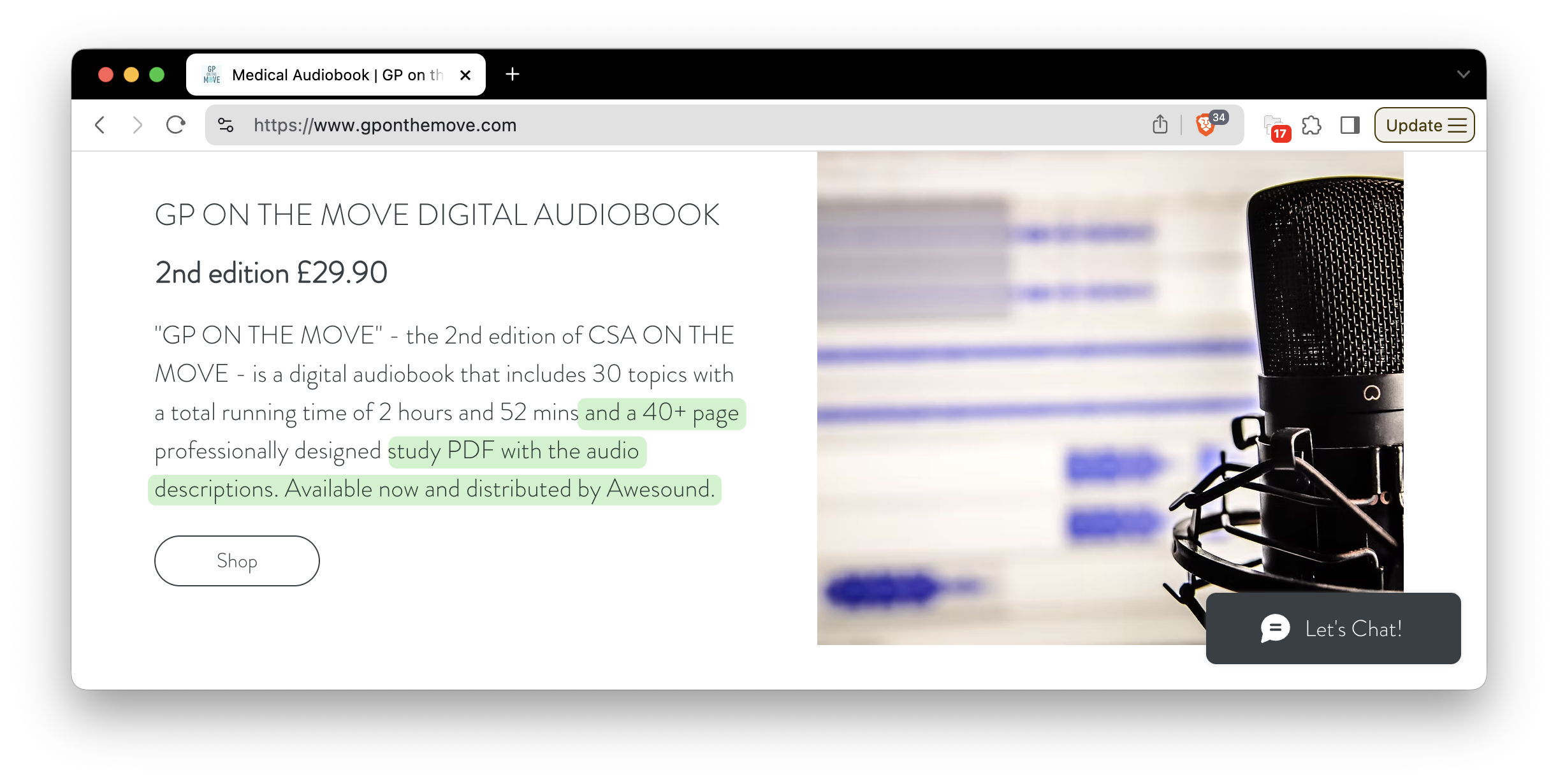 https://www.gponthemove.com/
Mr Moriarty built unique integrations with third parties
As outlined in our O-1 application in 2022, Mr Moriarty developed one-of-a-kind
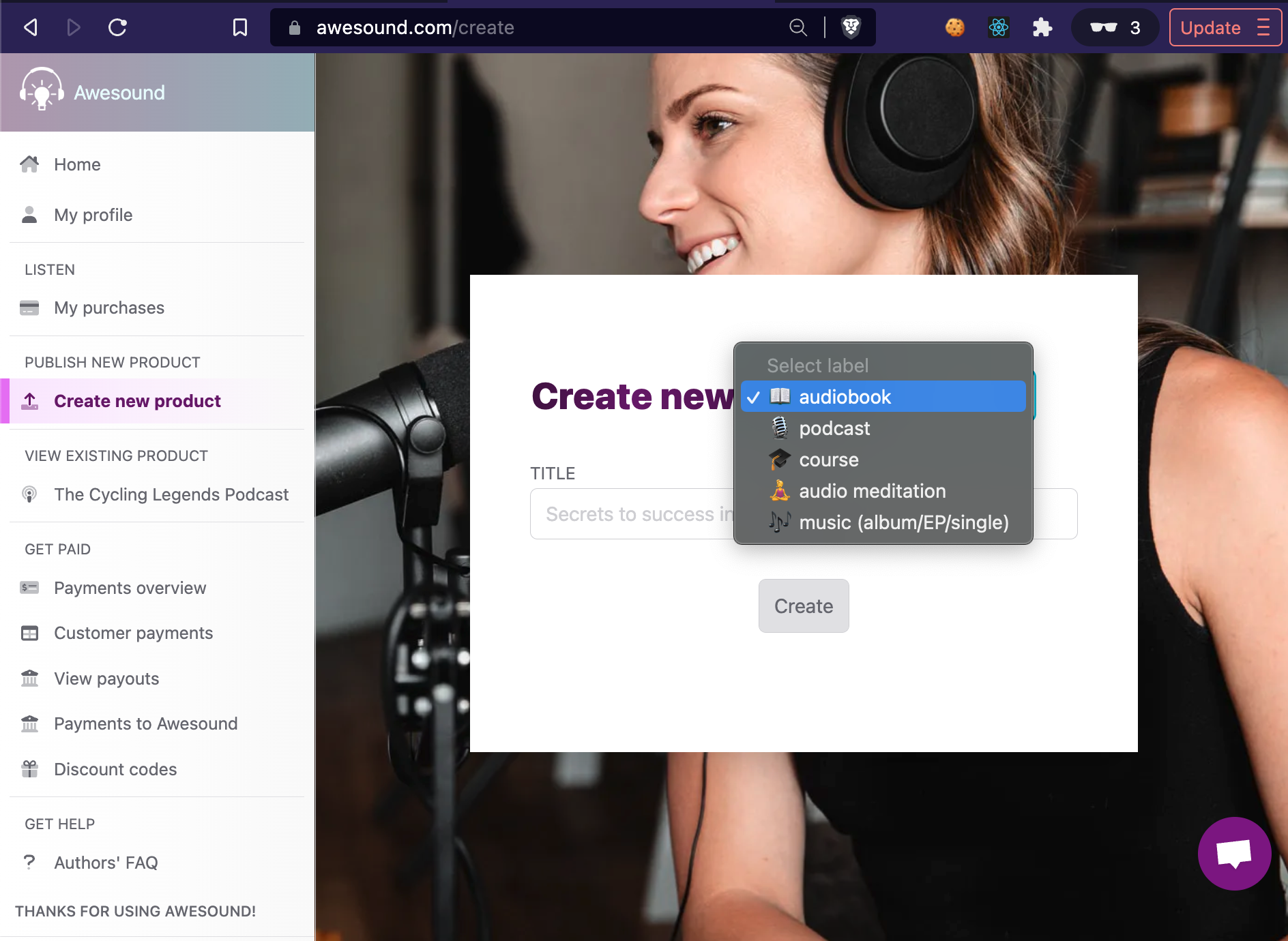 Screenshot from awesound.com/create, showing how easy it is to self-publish on Awesound.
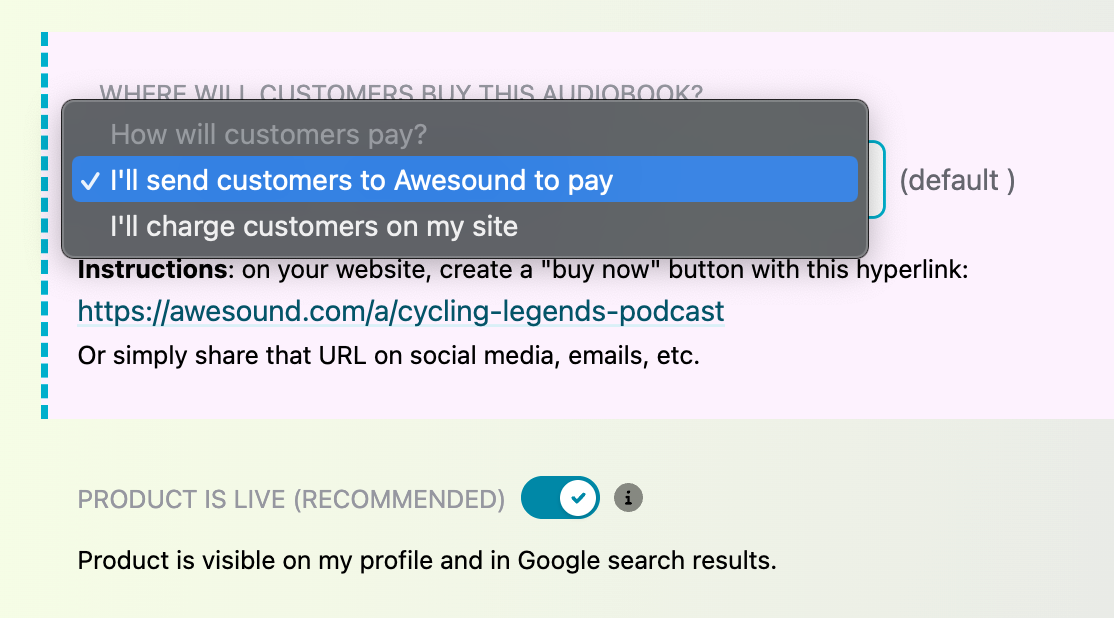
Zoomed-in screenshot from awesound.com/create, showing how Awesound also works with third party platforms such as Shopify, WooCommerce, Wix, etc.
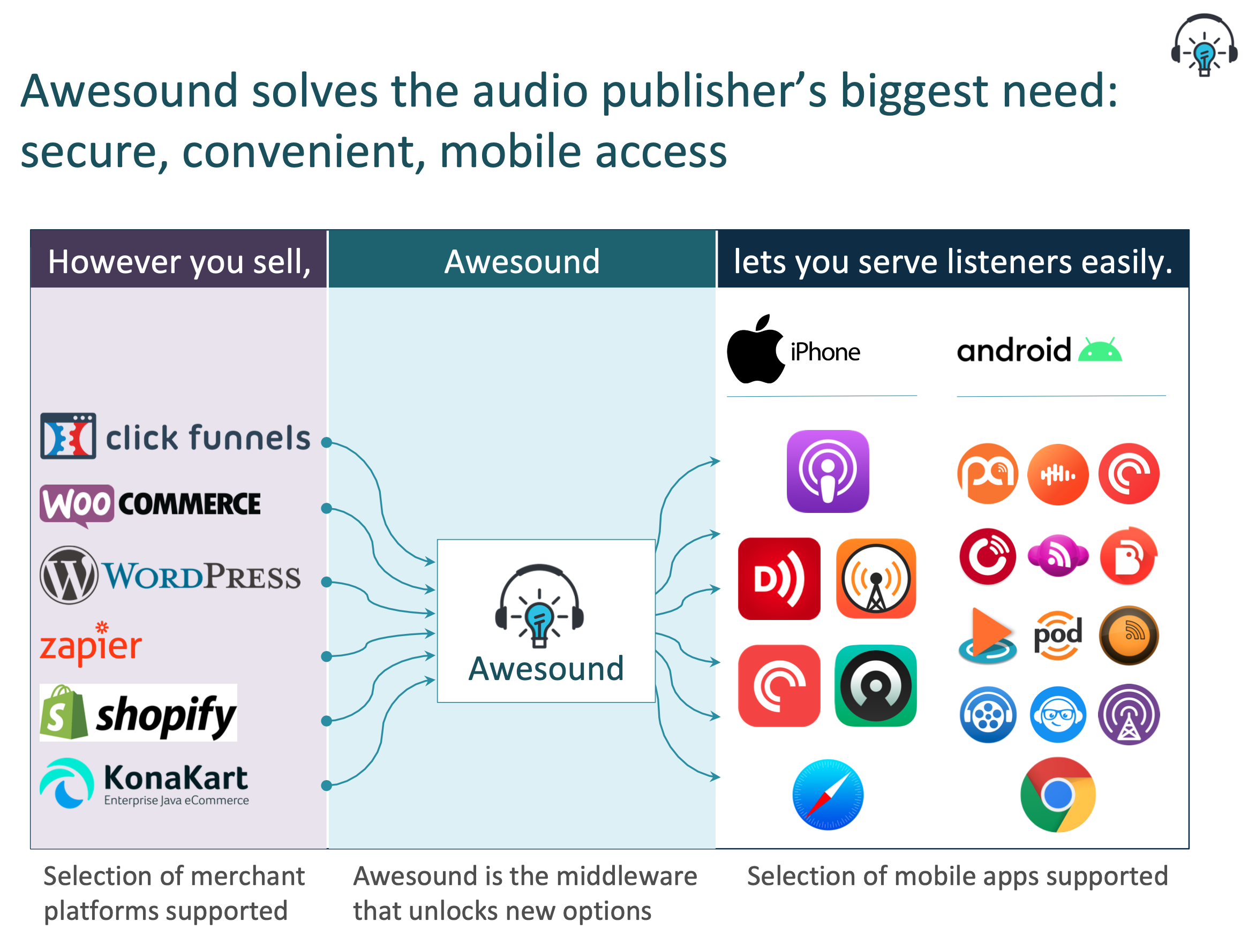 Graphic showing some of the many third-party platforms supported.
Awesound is a multiplier of American entrepeneurialism
Here’s what Awesound users say in their own words:
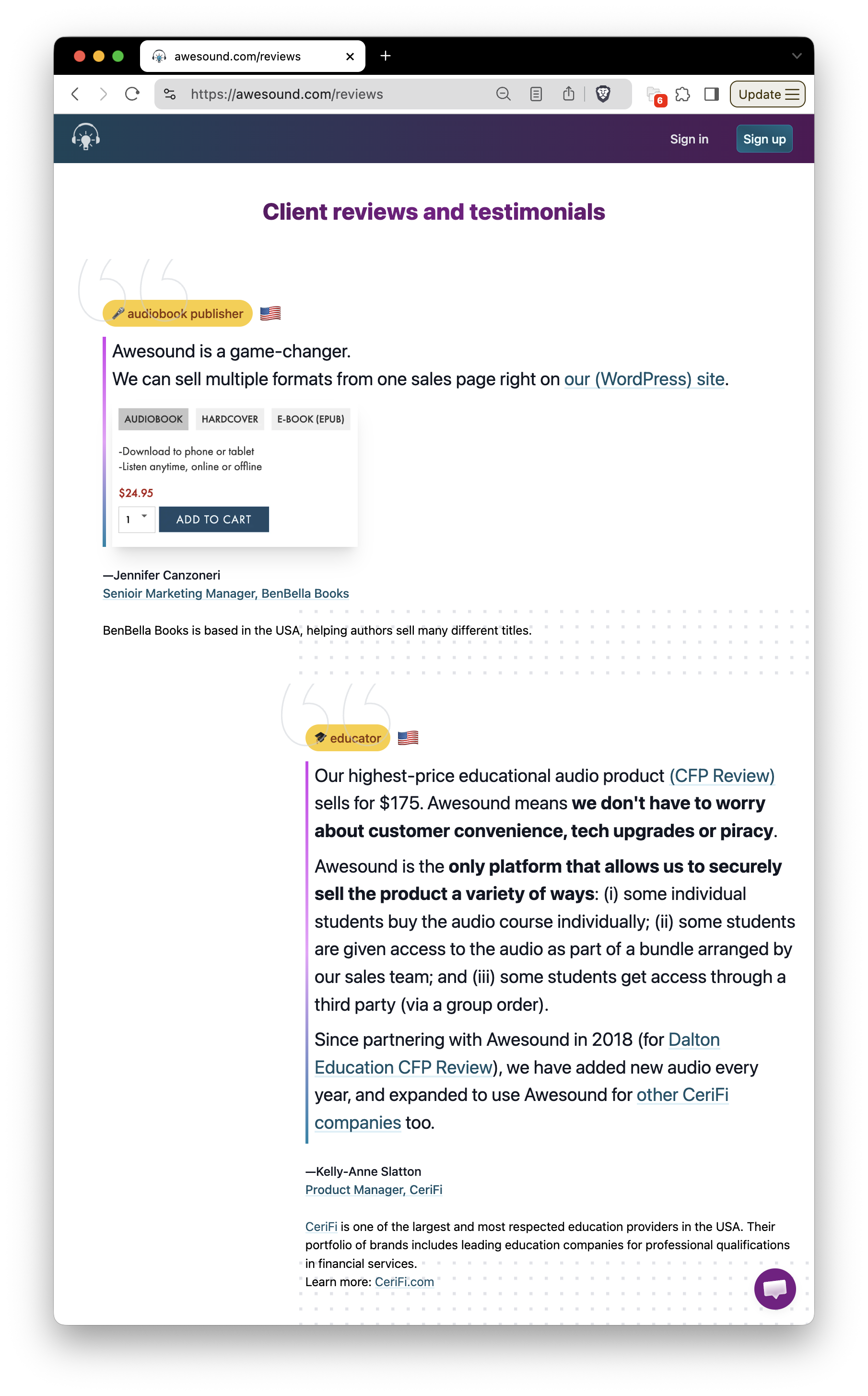
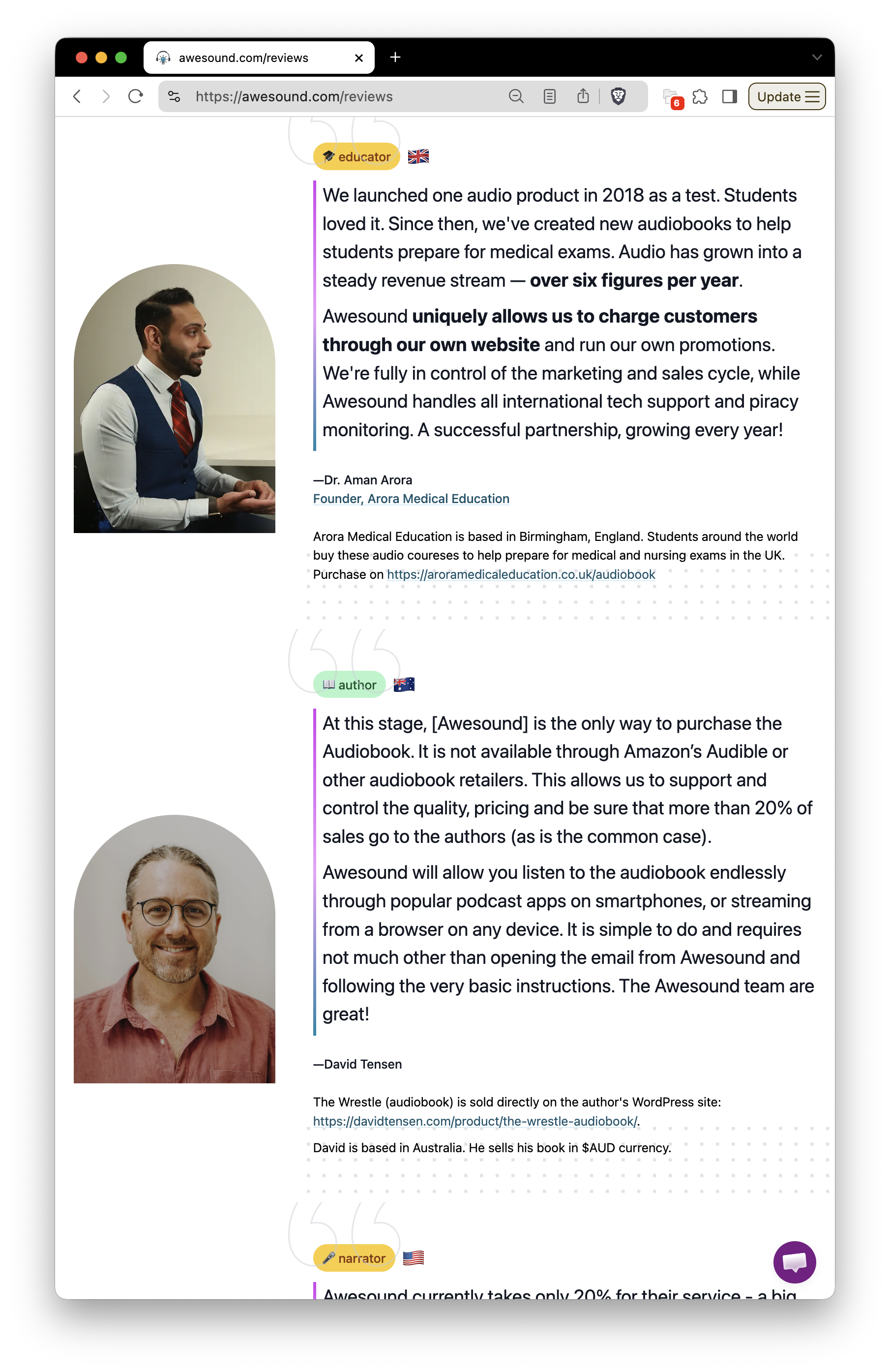
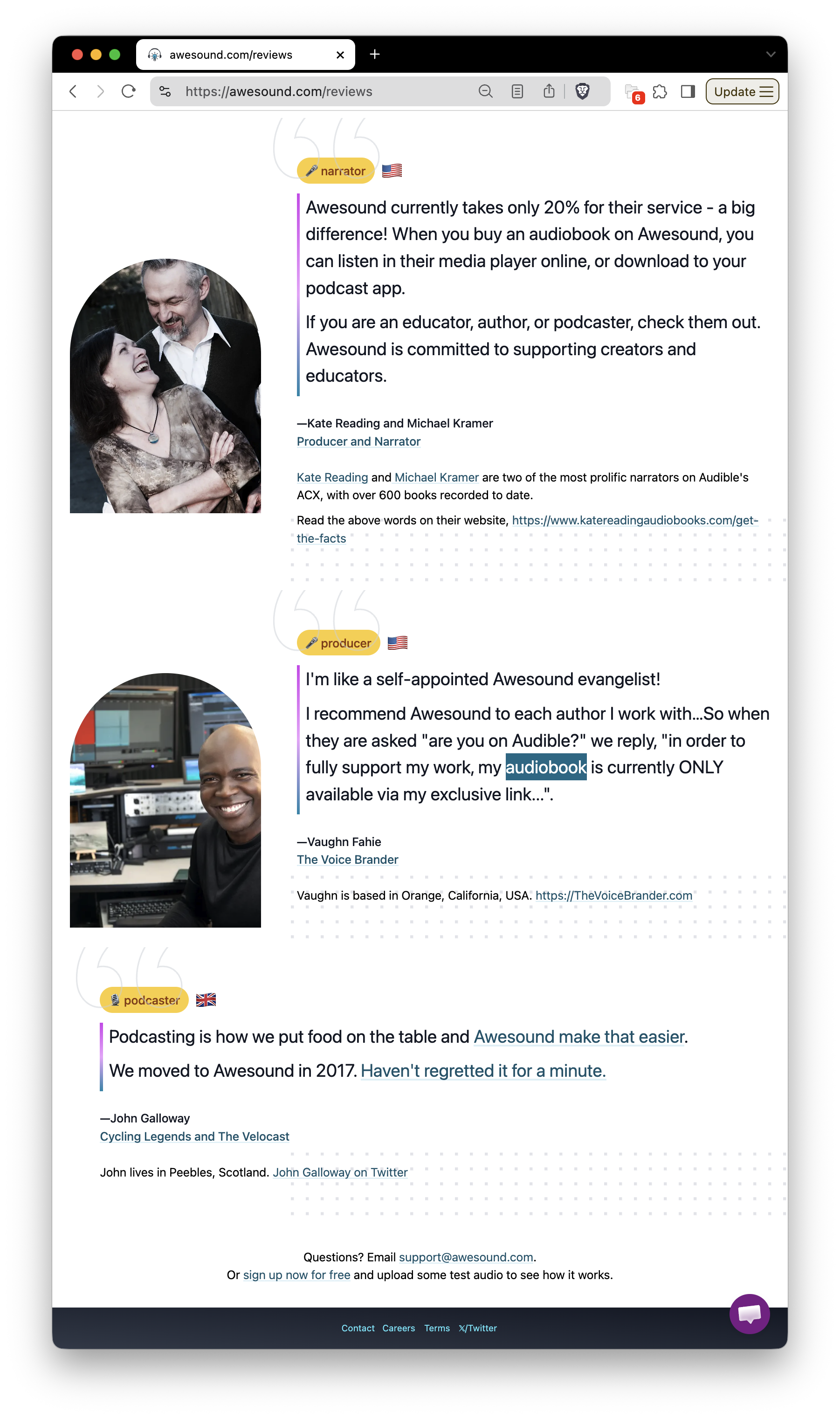 Three screenshots from https://awesound.com/reviews
Where quotes were online, quotes are hyperlinked to the original source (e.g., to the entrepreneur’s website, or to a tweet where they said that).
Three screenshots from https://awesound.com/reviews
Where quotes were online, quotes are hyperlinked to the original source (e.g., to the entrepreneur’s website, or to a tweet where they said that).
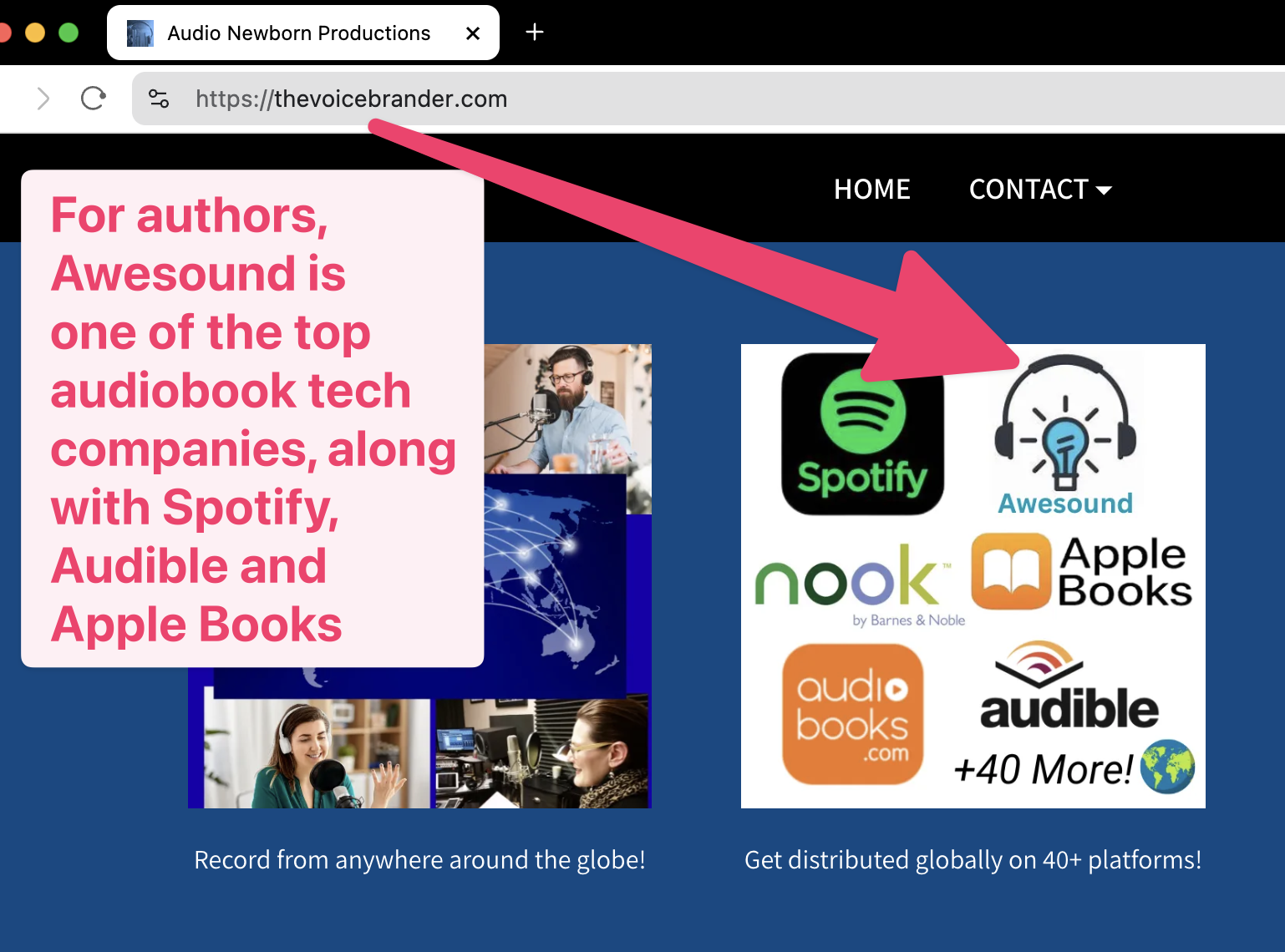 Annotated screenshot from https://thevoicebrander.com/
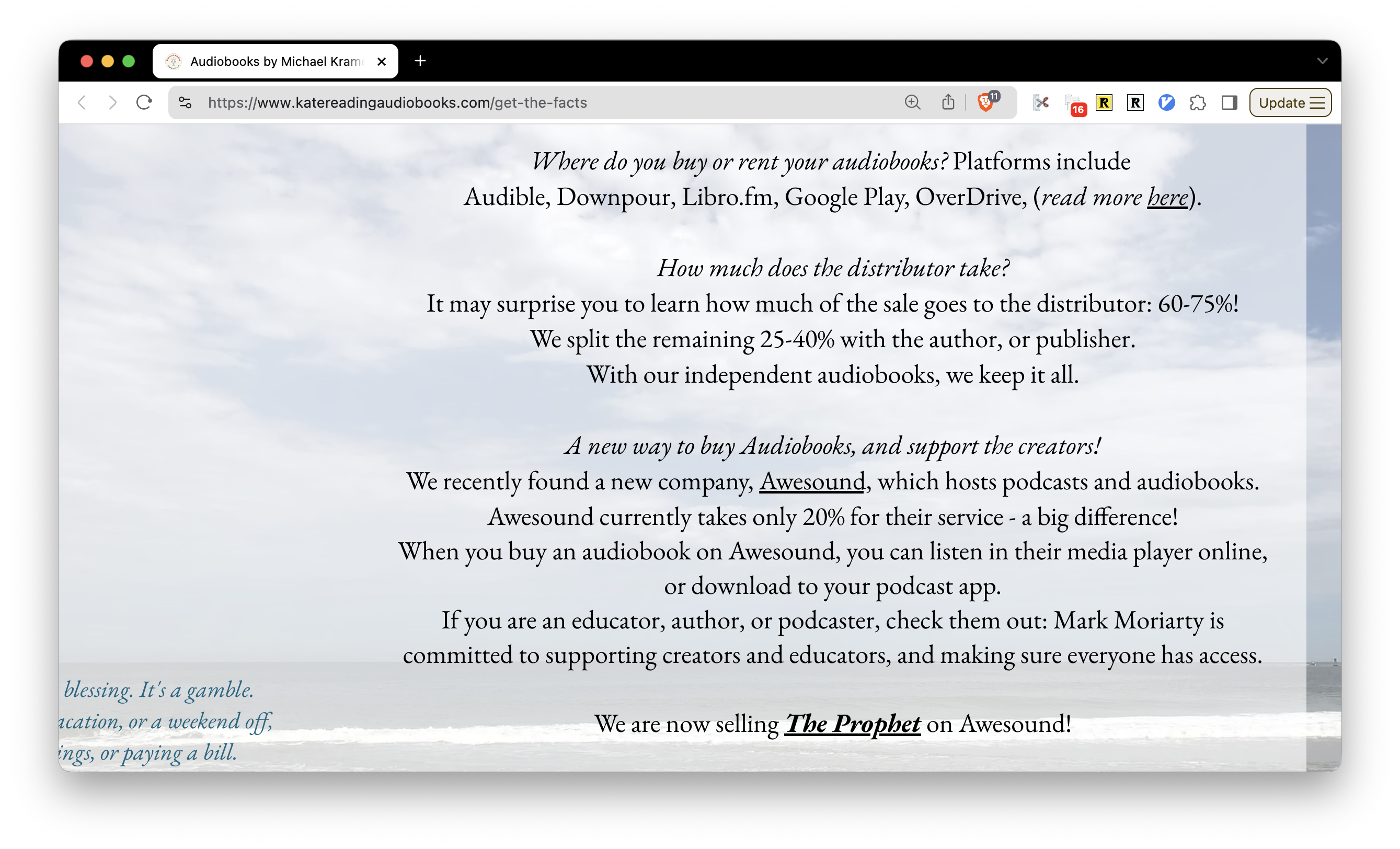 Screenshot from https://www.katereadingaudiobooks.com/get-the-facts
Kelly-Anne signed a letter commenting on how critical Awesound was to their business. Awesound is the audio partner for Dalton CFP audio:
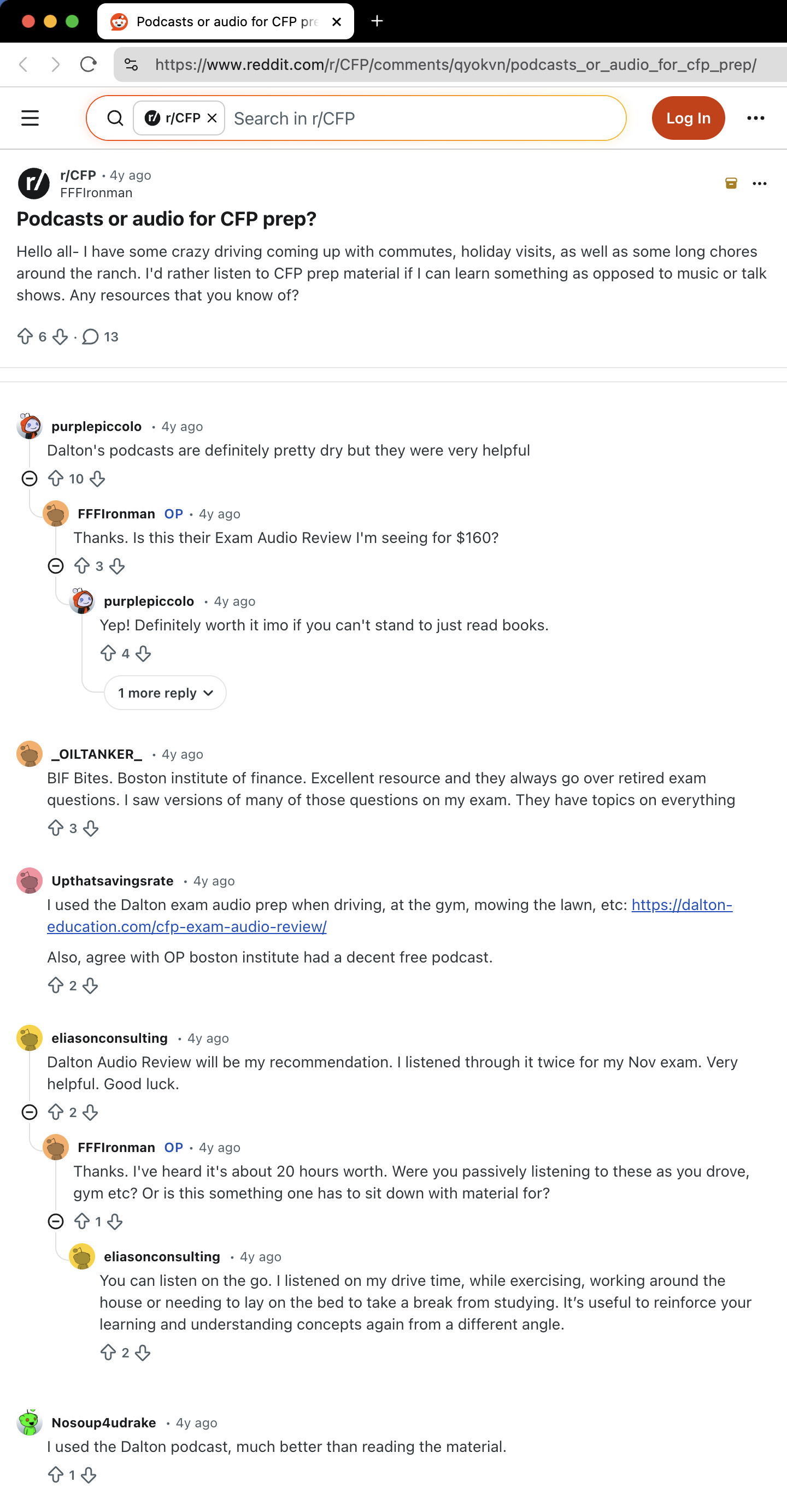 Screenshot from https://www.reddit.com/r/CFP/comments/qyokvn/podcasts_or_audio_for_cfp_prep/
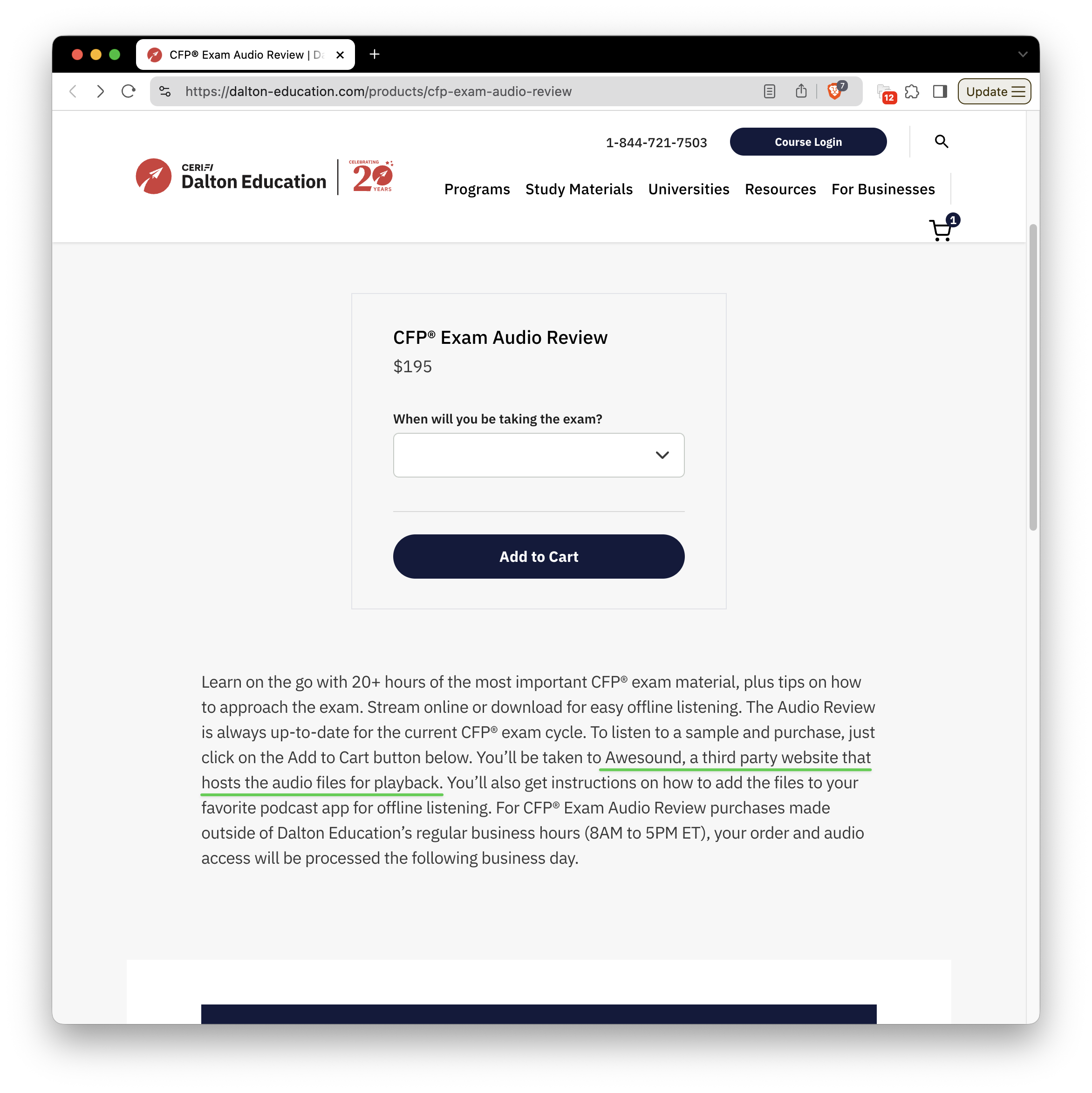 Screenshot from https://dalton-education.com/products/cfp-exam-audio-review
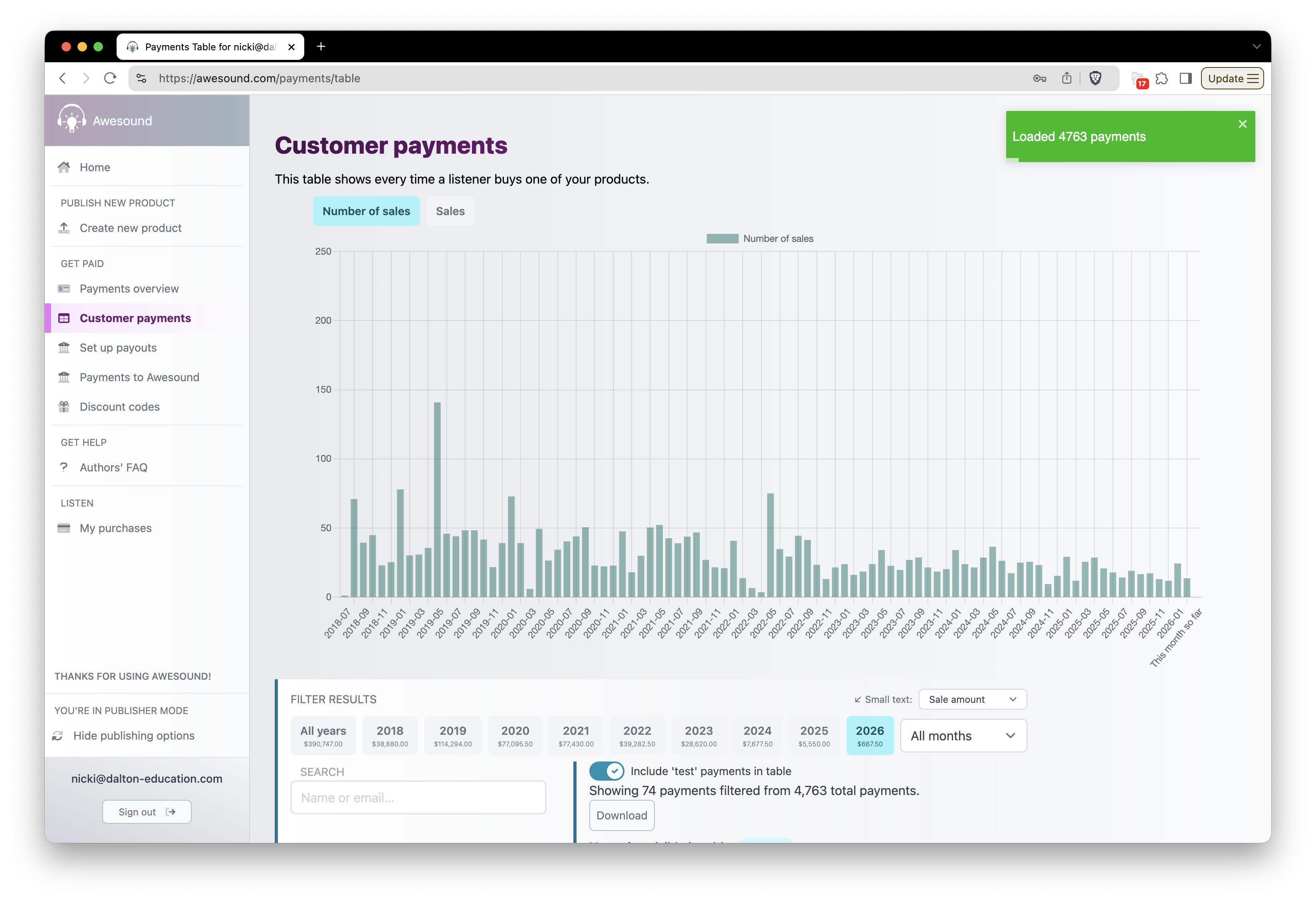 That publisher has almost 5,000 sales fulfilled by Awesound (roughly half through Awesound and half through their own website and channels)